
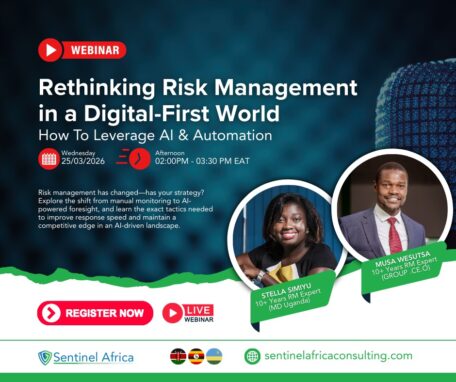
Rethinking Risk Management in a Digital First World – How To leverage AI & Automation
Table of Contents
Introduction
Risk management is changing.
Not slowly. Not theoretically. But in real, practical ways that are already affecting how organisations operate, make decisions, and respond to uncertainty.
In a recent Sentinel Africa webinar, Stella Simiyu (Managing Director, Uganda) and Musa Wesutsa(Group CEO, Sentinel Africa) led a deeply practical conversation on how risk management is evolving in a world shaped by AI, automation, and increasing complexity.
This was not a technical session.
It was a grounded, experience-driven discussion built from years of working across industries, institutions, and real risk environments.
And one thing became very clear:
Most organisations are still managing risk in ways that no longer match the world they operate in.
Risk Management Has Been Misunderstood
One of the strongest points that came out early in the conversation was this:
Risk management is not meant to slow organisations down.
It is meant to help them move better.
As Stella put it, if risk management is not helping the business grow, then it is not being done properly.
Too often, risk functions are brought in after decisions are made.
After strategy is defined.
After risks have already started materialising.
But in reality, risk managers are supposed to sit at the centre of decision-making.
They are the ones thinking about:
- what could happen next
- what could go wrong
- and what opportunities might be missed
Musa expanded on this by reframing risk itself.
Risk is not only about negative outcomes.
It is uncertainty.
And uncertainty carries both:
- potential loss
- and potential opportunity
The problem is, most organisations only focus on one side of that equation.
The Gap Between What We Say and What We Do
Another very real challenge discussed was the disconnect between risk appetite statements and actual behaviour.
Most organisations have well-written documents that define:
- how much risk they are willing to take
- what they want to avoid
- and where they want to grow
But when you look at day-to-day decisions, a different story emerges.
Projects get delayed.
Controls are not prioritised.
Risks that were flagged remain unaddressed.
Musa described this in a very simple but powerful way:
Organisations say one thing about risk, but behave differently.
This is where technology begins to play a role.
AI and structured systems allow organisations to:
- track how decisions are actually being made
- compare behaviour against stated risk appetite
- and identify where misalignment exists
It becomes less about reporting, and more about visibility.
A mirror, as he described it.
Residual Risk Is Not Something You Close
One of the most practical and relatable parts of the discussion was around residual risk.
In many organisations, risk registers create a false sense of completion.
You identify a risk.
You implement controls.
You reduce the score.
You mark it as closed.
But real life does not work that way.
Stella gave a relatable example using global shipping disruptions.
The risk itself is not new.
It has happened before.
Organisations are aware of it.
But when it actually materialises again, the impact is still significant.
Why?
Because the residual risk that was accepted was not fully understood.
Musa added an important clarification:
Residual risk is not the same as target risk.
It is simply the level of risk that remains after controls are applied.
And that level can change at any time.
Suppliers fail.
Dependencies break.
External environments shift.
What this means is that risk is not static.
It is something organisations are continuously sitting on.
And without systems to monitor it in real time, that visibility is lost.
From Reports to Real Time Risk Insight
Another key theme throughout the session was the limitation of traditional reporting.
Many organisations are still relying on:
- periodic risk reports
- manual dashboards
- historical data
But risk does not operate on a quarterly cycle.
It evolves daily.
AI introduces the ability to move from:
- static reporting
- to continuous monitoring
Musa broke this down using a simple progression:
Data becomes information.
Information becomes knowledge.
Knowledge becomes insight.
And ultimately, insight becomes decision-making.
This is where real value lies.
Not in collecting more data, but in making sense of it faster and more accurately.
Why Scenario Planning Often Fails
One of the most interesting parts of the conversation was around scenario planning.
In theory, organisations are encouraged to:
- imagine potential disruptions
- test their preparedness
- and plan for different outcomes
But in practice, this is difficult.
Not because organisations lack intelligence.
But because of human bias.
People struggle to imagine extreme scenarios.
They dismiss unlikely events.
They avoid uncomfortable conversations.
Musa shared a real example where a seemingly small operational issue was dismissed by leadership, only for it to later prove significant.
The challenge is not data.
It is perception.
This is where AI becomes powerful.
It removes:
- emotional bias
- assumptions
- and limitations in imagination
It allows organisations to simulate scenarios that may not feel obvious, but are entirely possible.
And as history has shown, many major risks were not unpredictable.
They were simply unimagined.
Communicating Risk in a Way That Drives Action
A key takeaway, especially for those working in risk functions, was around communication.
Risk reports often fail not because they are wrong.
But because they are not understood.
Boards and leadership teams do not need more detail.
They need clarity.
Musa shared a practical approach to this.
Instead of presenting multiple indicators and reports, simplify risk into a single score.
A number that reflects overall exposure.
This shifts the conversation from:
- explaining risk
to - acting on it
It becomes easier to align on:
- what needs to improve
- where focus should go
- and what success looks like
The Role of AI in Risk Management
Throughout the session, AI was not positioned as a replacement.
It was positioned as an enabler.
A tool that helps organisations:
- process more data
- identify patterns
- monitor changes
- and improve decision-making
But one point was made very clear.
AI does not replace experience.
It does not replace judgment.
It enhances it.
The effectiveness of AI in risk management still depends on:
- how it is implemented
- what it is used for
- and the level of control around it
Final Reflection
This was not a conversation about the future.
It was a reflection of what is already happening.
Risk management is no longer just about compliance.
It is becoming a core part of how organisations think, operate, and grow.
And the gap is widening.
Between those who are:
- still operating manually
and - those who are building real time, intelligent systems
As Stella and Musa emphasised throughout the session, the shift is already underway.
The question is not whether risk management will evolve.
It is whether organisations are ready to evolve with it.
Continue the Conversation
If you would like to explore how your organisation can strengthen its approach to risk management and begin integrating more intelligent, real time systems:
You can reach out to the Sentinel Africa team or book a session to continue the conversation.
No comments yet